
Sunday, May 21, 2017

Tuesday, September 29, 2015
It was seven years ago today ...
This is my very first entry, from my some-time-ago blog, PENCHANT, now closed.
If you find much meaning here, I'd like to know what it is.
Enter, view.
September 29th, 2008
Imaginary Character This interview is now in session.
Troy Howell Sounds like school to me.
IC Speaking of school, where did you go?
TH That should be: To where did you go. Captain Raymond Collins Elementary, Long Beach, California.
IC That’s it?
TH Isn’t that enough? My grammar proves it, I think.
IC I mean, any degrees … writing programs …
TH Oh, that. Sure. Plus the school of soft knocks.
IC Please expound.
TH To the degree that one suffers in life, giving, and the pursuit of happenings. Not to mention.
IC Not to mention?
TH Exactly.
IC Mr Howell, you made an interesting point earlier, something about grammar.
TH Yes. There’s the good and there's the bad.
IC No in-between?
TH And the in-between.
IC I mean, surely, you’re not one of those everything’s-black-or-white kind of guys?
TH Only when I’m drawing with graphite, charcoal, or pen and ink. Or writing with my trusty white Bic round stic fine USA, a pen that is increasingly hard to find these days, if you can find one, which is hard.
IC You’re being redundant.
TH Well, Mr Ick, I think we all can be redundant at times, now and then.
IC You’re still being … what did you call me?
TH Ick. Mr Ick.
IC I’m glad you included the Mister. Otherwise—
TH Otherwise this interview would come to a close?
IC Exactly. Moving on, earlier you mentioned the school of—
TH Soft knocks.
IC Is that anything like soft rock? Or Fort Knox?
TH Only to the degree that music—in the vehicle next door, say—can be deafening, or annoying, like a buzzing fly—
IC Don’t all flies buzz?
TH Not after they’re dead. But you interrupted. Or to the degree that the price of gold plummets.
IC Could you give our blog audience an example?
TH Gladly. Take this blogjam, for instance. I’m trying to download the theme of my tamest dreams, because I’m not into rounded corners, except on city streets, in case you cut it too close, or on pizzas, and the window vanishes on the computer screen. Every time. So I download a new browser, which is kind of like Bowser, the dog I always wanted. Ta-da! I can now download the theme of my tamest dreams (after my password is invalid, every time, and I’m prompted to create a new one, which I do, but which still is invalid, every time, and after I creep through the digital back door while some invisible programmer’s ancestor—I won’t say who—isn’t looking, and ta-da! I can download the theme. Then, Lo and behold—which is a biblical term the literary equivalent of, “Yo, check it” —now I get to upload the theme, but that name, the name of the theme of my tamest dreams, is already taken, which is kind of like “Reserved for Employee of the Month”, so I rename it with a past-tense form, and somebody—I won’t say who, because I don’t know—doesn’t like the name, and wants me to rename the rename, so— Where was I?
IC Lost?
TH Oh, yes. Ah-ha. A solution peers over the penumbral horizon like moonrise. I’ll just change the color of the header banner to white! Now everything’s white!
IC So you are, indeed, one of those—
TH Now I have a less-than-desired look, constructed of chagrin and technological vexation. But it will do. For now.
IC The ta-da moment.
TH Anyway, the point is, you have to work with stuff like that, to soften the knocks. I’m speaking metaphorically, of course. The terrain of life.
IC I see. What school did you go to?
TH That’s: To what school did you go.
IC Moving on, before we close this interview—
TH I’ve bored you, I see.
IC I’m glad you called me IC. Instead of that other word. Before we close this interview, you spoke of speaking metaphorically—
TH Yes. Take this interview, for example. You enter, you look around, you “view” the wordscape—
IC I don’t follow.
TH Wordscape. Like landscape, only it’s not made of terra firma, flora and fauna. But there are images nonetheless, some of which appear in the words before you, others on the pages within you, by the camera obscura of the intellect.
IC You’re outgribing, or something.
TH You’re imaginary, or something.
IC Could I be Humpty Dumpty?
TH OK.
 |
| illustration by Sir John Tenniel |
--------------------------------------------
Alice And what does outgrabe mean?
HD Well, outgribing is something between bellowing and whistling,
with a kind of sneeze in the middle.
(Regards to Lewis Carroll.)
Tuesday, October 14, 2014
dreams and death chants, part two
I’m sure I missed some beautiful country, driving through those hours when coyotes and criminals feel safer with the dark, though I passed a dead coyote along the rim of the San Luis Reservoir.
I arrived in San Jose to find that the gallery exhibiting Barron Storey’s work opened at 10, which left me time to be restless. 10 came and went and the gallery remained closed, so I lunched at a Thai place, returned to the gallery, and still it was closed. I called them, left a message. I emailed them, said I was right outside their door. I had come all this way, for art’s sake! Around noon they emailed back and said they had opened. By then I’d received a $40 parking ticket while straying along the streets twelve minutes too long, not paying attention.
It was worth the wait, and the ticket, too.
I bet most of you have seen at least one illustration of Storey’s, if you don’t have it on your bookshelf. The particular piece I’m referring to is the paperback cover of Golding’s Lord of the Flies. Here is the back cover art, minus the typography.

Barron is the most incredible draftsman ever. Here is one of the earliest works I kept of his.

He drew this cover in a Time magazine office based on a witness’ description of Howard Hughes over the phone, the night Hughes died. An amazing portrait considering there were no photos of the reclusive Hughes that were less than 20 years off date.
I walked into the gallery, Anno Domini.
Just as there are some aspects of life we have difficulty facing, so it was with the subject of this exhibition, titled Suicide. I viewed it as a fellow of humanity and as an artist, both perspectives impacting me. As with most art, a reproduction conveys little about the original. Seeing Barron’s art up close and intimately, you see through layers, literally and figuratively, trying to comprehend where it all comes from and how deep it goes. He opens his soul to you; you glimpse his torments. And, if you can look beyond the subject, you are fascinated by his intricacies and you see how they fascinate him.
I learned that this particular subject was his torment of torments. The first piece was one he drew from life. Death, rather: it was of his mother lying in a hospital bed after she swallowed rat poison. Enough rat poison, the doctor told him, to kill an army. Barron was 23.
For this collection of … I will call it work for the purpose of simplicity, though it involved not only sweat, but blood and tears … Barron had already been immersed in the subject for years: besides his mother, his uncle, Barron’s ex-wife, and a close friend took their own lives. There were over 70 works. Artistically, there was so much to learn by studying them I perused the exhibit three times.

Barron divided the art into clusters. Alongside each cluster he wrote in pencil or pen directly on the wall, defining a particular phase or sub-theme of the work. The cluster he numbered 5 reads What Good Am I? Cluster 7 represents work he did involving interviews he’d had with those who knew suicide victims. The cluster of work in 8 conveyed how the project itself affected him. I sensed it was near catastrophic.


The brochure for the exhibit reproduced Barron's remarks:
"Started asking people: Did you know anyone who committed suicide? So many did. Made drawings about each one. They piled up. Show them? Ugly ... Ugly subject. Ugly feelings. What have I done? OK. The question is: What did they do? And why? Pages and pages of journal drawings ... Lord, let it be over."
To be cont.
for dreams and death chants, part one, click here
I arrived in San Jose to find that the gallery exhibiting Barron Storey’s work opened at 10, which left me time to be restless. 10 came and went and the gallery remained closed, so I lunched at a Thai place, returned to the gallery, and still it was closed. I called them, left a message. I emailed them, said I was right outside their door. I had come all this way, for art’s sake! Around noon they emailed back and said they had opened. By then I’d received a $40 parking ticket while straying along the streets twelve minutes too long, not paying attention.
It was worth the wait, and the ticket, too.
I bet most of you have seen at least one illustration of Storey’s, if you don’t have it on your bookshelf. The particular piece I’m referring to is the paperback cover of Golding’s Lord of the Flies. Here is the back cover art, minus the typography.
Barron is the most incredible draftsman ever. Here is one of the earliest works I kept of his.
He drew this cover in a Time magazine office based on a witness’ description of Howard Hughes over the phone, the night Hughes died. An amazing portrait considering there were no photos of the reclusive Hughes that were less than 20 years off date.
I walked into the gallery, Anno Domini.
Just as there are some aspects of life we have difficulty facing, so it was with the subject of this exhibition, titled Suicide. I viewed it as a fellow of humanity and as an artist, both perspectives impacting me. As with most art, a reproduction conveys little about the original. Seeing Barron’s art up close and intimately, you see through layers, literally and figuratively, trying to comprehend where it all comes from and how deep it goes. He opens his soul to you; you glimpse his torments. And, if you can look beyond the subject, you are fascinated by his intricacies and you see how they fascinate him.
I learned that this particular subject was his torment of torments. The first piece was one he drew from life. Death, rather: it was of his mother lying in a hospital bed after she swallowed rat poison. Enough rat poison, the doctor told him, to kill an army. Barron was 23.
For this collection of … I will call it work for the purpose of simplicity, though it involved not only sweat, but blood and tears … Barron had already been immersed in the subject for years: besides his mother, his uncle, Barron’s ex-wife, and a close friend took their own lives. There were over 70 works. Artistically, there was so much to learn by studying them I perused the exhibit three times.
Barron divided the art into clusters. Alongside each cluster he wrote in pencil or pen directly on the wall, defining a particular phase or sub-theme of the work. The cluster he numbered 5 reads What Good Am I? Cluster 7 represents work he did involving interviews he’d had with those who knew suicide victims. The cluster of work in 8 conveyed how the project itself affected him. I sensed it was near catastrophic.
"Started asking people: Did you know anyone who committed suicide? So many did. Made drawings about each one. They piled up. Show them? Ugly ... Ugly subject. Ugly feelings. What have I done? OK. The question is: What did they do? And why? Pages and pages of journal drawings ... Lord, let it be over."
To be cont.
for dreams and death chants, part one, click here
Sunday, October 5, 2014
dreams and death chants, part one
I never did tell you about my California adventure. Not that I had only one — I was born and raised in California and my adventures were many, like the time a bear stole my backpack high in the Sierras, or when the hood (the bonnet, in Britspeak) flew off my ’59 Jag on the Pasadena freeway, or when I nearly died from a bee sting …
But on a more recent occasion, while visiting family and friends, I was headed to the Central Valley from Long Beach, and had become so sick with a respiratory flu I wanted to clear my head and body in the wilds. I wanted clean air and uncluttered space.
It happened fortuitously. I missed the right fork in the freeway, literally, which put me on the 5, still heading north but a bit closer to the coast. On this stretch the country is wide open, dusty, and uninviting. Deciding to postpone my stay with my octogenarian mother (not wishing to compromise her health), I proceeded.
I saw that Pacheco State Park was a couple of hours away. I imagined trekking through dry grasses, over hills studded with oaks, sketchbook-ready, inspired. A picture formed in my mind of a lone live oak on a hill, spreading like a Rorschach test over the barrenness. I knew how I’d render the leaves; I knew how I’d render the grass.
My fever rose so high at times I felt the fringes of delirium.
As I drove further north and west, I recalled a Robin Williamson song.
Purple clouds turn scarlet in the setting sun
Where sagebrush turns to live oak and the white-tail run
The air is cool as music when the day is done
And God paints the sky above Pacheco
Driving all day up the San Joaquin
Turn west again, up through Pacheco
Through the blue hills back of Santa Cruz we're rolling fine
Where red-tailed hawks go circling like the waves of time
Lovers and friends will meet again around red Sonoma wine
When God calls the night above Pacheco
I drove all day and into the evening, arriving at a place I thought was near Los Gatos — The Cats (named after the mountain lions and bobcats indigenous to the region) — where John Steinbeck wrote The Grapes of Wrath and violinist Yehudi Menuhin lived as a boy. But, getting sicker by the mile, I pulled into a KOA and sat for a moment. It was early evening and I was in Los Banos — The Baths. I hoped to rest a few hours, shower, and get back on the road to somewhere more scenic, expecting to be well enough to draw my dreamscape.
My fever dropped, my appetite returned, and I found a Panda Express near a truck stop. To get to the door I had to wade through a whine of feral cats, begging with their hungry tongues and their hollow eyes. They were all the same dirty beige. As I ate I watched them watching me, with a picture window between us. I could eat only part of my meal, and cracked open the fortune cookie, which prophesied:
You will meet an old friend.
Feeling worse again, I returned to the KOA, registered at the desk, and pulled into a spot to sleep. More cats surrounded a dumpster in the distance—surreal, ghost-colored cats, all the same dirty beige. My fever went up again and I sat there in a sweat. I decided to take a shower. On the way to the showers I passed the community room, a large windowed porch off the main office. Under cold, harsh lights people not much older than I shared a potluck meal, camaraderie, and card games. What a ghastly way to spend your life. But each of us must find his own happiness. They all seemed happy. In the mens room I saw a phantom in the mirror that looked too sick to shower, so I went back to the car. Perhaps in the morning I’d feel better. My fever would not quit. The night was a continuous John Fahey death chant. I sat and gazed at the dumpster. All the cats were gone but one, a sentry, perched on the lid, watching for rats. I shared my misery with it.

Around 4 am my fever broke. I was ready to get back on the road. I headed for the showers again but the door was locked. After retrieving the code from my car, I still could not get in. I lose patience with such things. The code had been hastily jotted down by the woman behind the desk, and after I realized the 8 was actually a 3, it was too late. By the time I had finished punching numbers I’m sure I’d re-programed the lock. I ended up in a posh outhouse, washing my head in the sink and taking what the locals back where I live call a sponge bath (from an earlier time when wells went dry and you had to conserve), avoiding the black widows all the while.
Enough. I was ready to see the sun, see the sea. Though my fever had dropped, I coughed like a dog. Changing my plans, I headed for San Jose. There was a gallery that displayed the works of an instructor I’d had during my Art Center days in Pasadena. Barron Storey. He’s in his seventies now. I had to see what he was up to.
for dreams and death chants, part two, click here
cover art from a John Fahey album
But on a more recent occasion, while visiting family and friends, I was headed to the Central Valley from Long Beach, and had become so sick with a respiratory flu I wanted to clear my head and body in the wilds. I wanted clean air and uncluttered space.
It happened fortuitously. I missed the right fork in the freeway, literally, which put me on the 5, still heading north but a bit closer to the coast. On this stretch the country is wide open, dusty, and uninviting. Deciding to postpone my stay with my octogenarian mother (not wishing to compromise her health), I proceeded.
I saw that Pacheco State Park was a couple of hours away. I imagined trekking through dry grasses, over hills studded with oaks, sketchbook-ready, inspired. A picture formed in my mind of a lone live oak on a hill, spreading like a Rorschach test over the barrenness. I knew how I’d render the leaves; I knew how I’d render the grass.
My fever rose so high at times I felt the fringes of delirium.
As I drove further north and west, I recalled a Robin Williamson song.
Purple clouds turn scarlet in the setting sun
Where sagebrush turns to live oak and the white-tail run
The air is cool as music when the day is done
And God paints the sky above Pacheco
Driving all day up the San Joaquin
Turn west again, up through Pacheco
Through the blue hills back of Santa Cruz we're rolling fine
Where red-tailed hawks go circling like the waves of time
Lovers and friends will meet again around red Sonoma wine
When God calls the night above Pacheco
I drove all day and into the evening, arriving at a place I thought was near Los Gatos — The Cats (named after the mountain lions and bobcats indigenous to the region) — where John Steinbeck wrote The Grapes of Wrath and violinist Yehudi Menuhin lived as a boy. But, getting sicker by the mile, I pulled into a KOA and sat for a moment. It was early evening and I was in Los Banos — The Baths. I hoped to rest a few hours, shower, and get back on the road to somewhere more scenic, expecting to be well enough to draw my dreamscape.
My fever dropped, my appetite returned, and I found a Panda Express near a truck stop. To get to the door I had to wade through a whine of feral cats, begging with their hungry tongues and their hollow eyes. They were all the same dirty beige. As I ate I watched them watching me, with a picture window between us. I could eat only part of my meal, and cracked open the fortune cookie, which prophesied:
You will meet an old friend.
Feeling worse again, I returned to the KOA, registered at the desk, and pulled into a spot to sleep. More cats surrounded a dumpster in the distance—surreal, ghost-colored cats, all the same dirty beige. My fever went up again and I sat there in a sweat. I decided to take a shower. On the way to the showers I passed the community room, a large windowed porch off the main office. Under cold, harsh lights people not much older than I shared a potluck meal, camaraderie, and card games. What a ghastly way to spend your life. But each of us must find his own happiness. They all seemed happy. In the mens room I saw a phantom in the mirror that looked too sick to shower, so I went back to the car. Perhaps in the morning I’d feel better. My fever would not quit. The night was a continuous John Fahey death chant. I sat and gazed at the dumpster. All the cats were gone but one, a sentry, perched on the lid, watching for rats. I shared my misery with it.
Around 4 am my fever broke. I was ready to get back on the road. I headed for the showers again but the door was locked. After retrieving the code from my car, I still could not get in. I lose patience with such things. The code had been hastily jotted down by the woman behind the desk, and after I realized the 8 was actually a 3, it was too late. By the time I had finished punching numbers I’m sure I’d re-programed the lock. I ended up in a posh outhouse, washing my head in the sink and taking what the locals back where I live call a sponge bath (from an earlier time when wells went dry and you had to conserve), avoiding the black widows all the while.
Enough. I was ready to see the sun, see the sea. Though my fever had dropped, I coughed like a dog. Changing my plans, I headed for San Jose. There was a gallery that displayed the works of an instructor I’d had during my Art Center days in Pasadena. Barron Storey. He’s in his seventies now. I had to see what he was up to.
for dreams and death chants, part two, click here
cover art from a John Fahey album
Monday, April 28, 2014
The Magical with the Mundane
My Writing Process
A writer friend and critique partner, Brian Rock, has invited me to an ongoing blog tour that includes many other writers. Here are my answers to some frequently asked questions.
What am I working on? Hans Andersen’s Ghost, a magic realism middle grade novel. And a rough draft for a companion book to follow The Dragon of Cripple Creek. And when the ideas come (which have been often, lately) a few picture book stories. And, and, and …

How is the work different from others in its genre? First, everyone is “different” if they’re tuned in to their own uniqueness and voice. I don’t follow trends. My primary inspirations come from within. In the case of my work in progress, I’ve added the imaginative works of Hans Christian Andersen (minus his excessive sentimentality), as a source of material. My works tend to concentrate on the private world of the lone child, rather than on a communal or social circumstance. Also, how I say it is as important as what I say.
Why do I write what I do? Passion. Playing with words and ideas. The joy of sharing. Through my work I can say, “Look! See! Discover! Wonder!” As I present matters that catch my mind and eye and heart, I want it to be as enjoyable and purposeful as I can make it, something that both captivates and reveals. I prefer to use magic realism, merging make-believe with the real, because life is so full of mysteries and hidden truths. I especially like contrast: the confident with the fearful; the meek with the mighty; ancient with modern; magical with mundane. It’s kind of a literary chiaroscuro. And if my stories awaken something within the reader, that’s rewarding.
How does my writing process work? It begins with an idea. Sometimes the idea comes from a desire to write about a particular situation—say, what happens when a child’s imagination is suppressed—or an image in my mind, or a blend of randomness and logic. For The Dragon of Cripple Creek, it began with wanting to put a dragon in North America. What naturally followed was to write a new American tall tale, to juxtapose something ancient with today’s world. Dragons are not really my thing, and I wanted to stay clear of the dragon stereotype. If anyone were to breathe fire, it would be the girl who discovered the dragon, not the dragon himself. The idea was appealing enough that once it held me I couldn’t let go until I had seen it through. For Hans Andersen’s Ghost, it began with an image in my mind: a boy in modern Copenhagen who dons Andersen’s old top hat to find himself in Andersen’s imaginary world, a place no less perilous than his own. I believe Andersen’s tales run the risk of losing relevancy, if not vanishing altogether. This is my way of introducing him in a new way to a new generation. (How many know that it was he who wrote "The Little Mermaid," and not Disney? How many know she dies in the end ...)

Being a visual artist, I often do a sketch in anticipation of the work.
Once I like an idea enough to pursue it, I begin by writing the first lines to see where it goes and to get a sense of its voice. These beginning lines feed what will follow. It’s a matter of creating something of quality and uniqueness that inspires me to continue. There comes a time where I adjust and organize the action to a satisfactory climax, but I’ve found that if my beginning isn’t just right, there’s no need to continue, because everything flows from that.
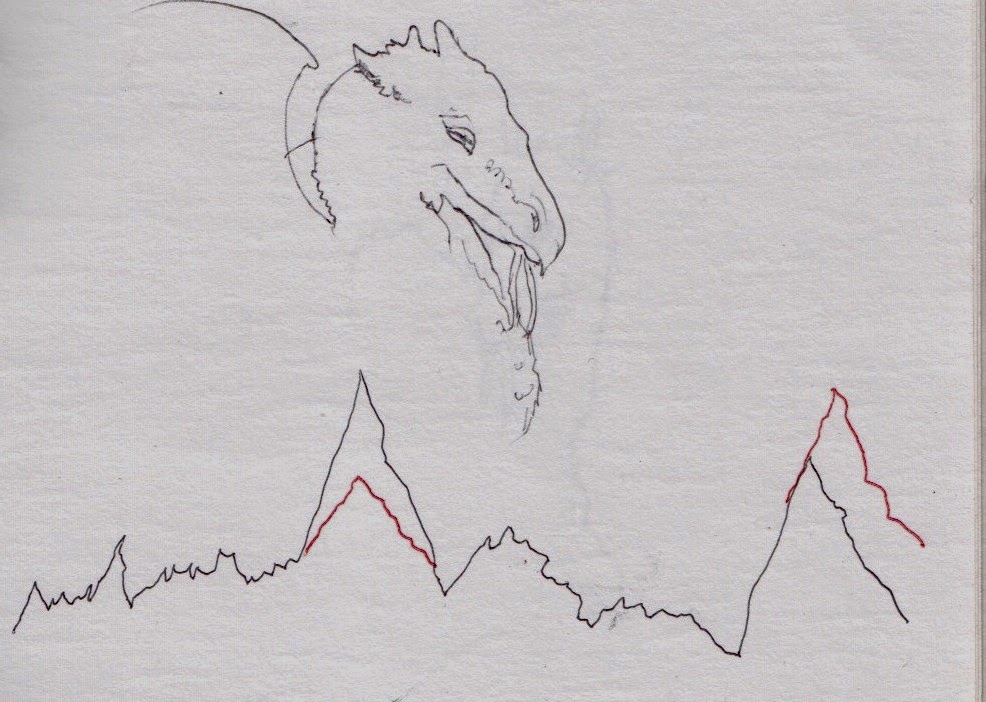
The mountainous plot chart I sketched for The Dragon of Cripple Creek to help me see where the high action points were occurring. After rating them as you would elevations in the Rockies (which is where the story takes place), I concluded that the mid-point climax was greater than the final. I had to revise both, indicated by the red lines.
So it’s the beginning where I spend the most time and concentration. It becomes very intense; it works into my dreams. The beginning, which is about the first 25 pages, also shows me a glimpse of theme or themes, the true why of that particular work, and once I have a clearer sense of what I’m saying, I can write with more certainty. More thought goes into this portion than actual writing does. I will then work on the end until I’m satisfied with where it’s going, and the rest involves tying the two together. I begin as an explorer, and become a discoverer, a surveyor, an engineer, an architect.
As to daily word count, I don’t keep track. Some days I may write hundreds of words, even a thousand, some days only a few. It really depends on where I am in the process. Some days I pace and think and talk it out of myself.
Part of the process includes subjecting my work to the fresh eyes and minds of a critique group (in my case, the Richmond Children's Writers), a valuable resource for any serious writer.
As to the physicality of it, I sit at my table and torture the keyboard, with a cup of espresso nearby and the chaos and calm of nature outside my window.
A writer friend and critique partner, Brian Rock, has invited me to an ongoing blog tour that includes many other writers. Here are my answers to some frequently asked questions.
What am I working on? Hans Andersen’s Ghost, a magic realism middle grade novel. And a rough draft for a companion book to follow The Dragon of Cripple Creek. And when the ideas come (which have been often, lately) a few picture book stories. And, and, and …
How is the work different from others in its genre? First, everyone is “different” if they’re tuned in to their own uniqueness and voice. I don’t follow trends. My primary inspirations come from within. In the case of my work in progress, I’ve added the imaginative works of Hans Christian Andersen (minus his excessive sentimentality), as a source of material. My works tend to concentrate on the private world of the lone child, rather than on a communal or social circumstance. Also, how I say it is as important as what I say.
Why do I write what I do? Passion. Playing with words and ideas. The joy of sharing. Through my work I can say, “Look! See! Discover! Wonder!” As I present matters that catch my mind and eye and heart, I want it to be as enjoyable and purposeful as I can make it, something that both captivates and reveals. I prefer to use magic realism, merging make-believe with the real, because life is so full of mysteries and hidden truths. I especially like contrast: the confident with the fearful; the meek with the mighty; ancient with modern; magical with mundane. It’s kind of a literary chiaroscuro. And if my stories awaken something within the reader, that’s rewarding.
How does my writing process work? It begins with an idea. Sometimes the idea comes from a desire to write about a particular situation—say, what happens when a child’s imagination is suppressed—or an image in my mind, or a blend of randomness and logic. For The Dragon of Cripple Creek, it began with wanting to put a dragon in North America. What naturally followed was to write a new American tall tale, to juxtapose something ancient with today’s world. Dragons are not really my thing, and I wanted to stay clear of the dragon stereotype. If anyone were to breathe fire, it would be the girl who discovered the dragon, not the dragon himself. The idea was appealing enough that once it held me I couldn’t let go until I had seen it through. For Hans Andersen’s Ghost, it began with an image in my mind: a boy in modern Copenhagen who dons Andersen’s old top hat to find himself in Andersen’s imaginary world, a place no less perilous than his own. I believe Andersen’s tales run the risk of losing relevancy, if not vanishing altogether. This is my way of introducing him in a new way to a new generation. (How many know that it was he who wrote "The Little Mermaid," and not Disney? How many know she dies in the end ...)
Being a visual artist, I often do a sketch in anticipation of the work.
Once I like an idea enough to pursue it, I begin by writing the first lines to see where it goes and to get a sense of its voice. These beginning lines feed what will follow. It’s a matter of creating something of quality and uniqueness that inspires me to continue. There comes a time where I adjust and organize the action to a satisfactory climax, but I’ve found that if my beginning isn’t just right, there’s no need to continue, because everything flows from that.
The mountainous plot chart I sketched for The Dragon of Cripple Creek to help me see where the high action points were occurring. After rating them as you would elevations in the Rockies (which is where the story takes place), I concluded that the mid-point climax was greater than the final. I had to revise both, indicated by the red lines.
So it’s the beginning where I spend the most time and concentration. It becomes very intense; it works into my dreams. The beginning, which is about the first 25 pages, also shows me a glimpse of theme or themes, the true why of that particular work, and once I have a clearer sense of what I’m saying, I can write with more certainty. More thought goes into this portion than actual writing does. I will then work on the end until I’m satisfied with where it’s going, and the rest involves tying the two together. I begin as an explorer, and become a discoverer, a surveyor, an engineer, an architect.
As to daily word count, I don’t keep track. Some days I may write hundreds of words, even a thousand, some days only a few. It really depends on where I am in the process. Some days I pace and think and talk it out of myself.
Part of the process includes subjecting my work to the fresh eyes and minds of a critique group (in my case, the Richmond Children's Writers), a valuable resource for any serious writer.
As to the physicality of it, I sit at my table and torture the keyboard, with a cup of espresso nearby and the chaos and calm of nature outside my window.
Friday, April 25, 2014

Monday, January 27, 2014


Saturday, December 28, 2013
Ga t he r i n gG h o s ts

n open fireplace serves little purpose than to coat a thin layer of charity across whatever appears in its light. Don’t count on it to warm your room, much less your heart. Turn from the fire on a winter’s night, and the shadows wrap you up cold.
But it does burn.
The night of which I write had me facing the fire in my study, while behind me, beyond my candle-lit desk, where paper and pen waited for inspiration, snow assaulted the windows. The power was out, so I welcomed the flames more than they usually deserved. The north corner of the house shivers at times like this.
I stood contemplating the temperature at which paper burns and how, thanks to Mr. Bradbury, we all know what that means. We who are readers, that is. We readers know individuals who have spilled out of pages and into our minds, heroes and heroines who, like us, have simple needs, simple goals. We know what happens when you toss water on a witch. What a child can achieve by saving a runt pig. How to find Wonderland, where the Wild Things are.
It was Marley’s ghost who menaced me that night.
I had pulled books from the shelves, books with ghosts in them, to surround myself in their wealth, to revisit the tales that had gone before, to nudge my urge to write a ghost story. On the footstool lay Beagle’s A Fine and Private Place, a bittersweet novel inhabited by lovers Michael and Laura, who manage to hold to their memories; near it, The Legend of Sleepy Hollow, that timeless tale haunted by the headless horseman; the classic Wuthering Heights; the grief-stricken Hamlet; and Sebold’s contemporary The Lovely Bones, where Susie Salmon wanders her personal purgatory and the neighborhood she once thought harmless. A Christmas Carol spread open at my feet, the fire lighting half an illustration of Marley, poor soul, anchored to his money and remorse.
As I poked the fire in thought, searching for something new, his chains clinked suddenly nearby, and there stood Marley himself, in the flesh—or rather, spirit.
Leaving the poker ember-bound, I straightened up, and in an effort to not be unnerved, said loudly, “How’s Ebenezer?”
Marley loosened the rag that held up his jaw. “I’ve been watching you,” he said. “And my advice is—do not.”
In another attempt, I laughed, but it came out unsteady. “What business is it of yours?”
He leaned toward me, a tug on his weighted chains. “There are enough of us already!”
I looked him in the eye then (just one, for the other was lost to the dark), and said, “I have every right to my own ghost story.”
He flopped a hand toward me. “I entreat you—”
“I am not your beloved Scrooge!”
“—there are enough of us who suffer, fated, doomed!”
“Why do you trouble me? Had I known you’d object, I’d have left you on the shelf.”
After a long silence, in which a pine knot spat among the flames, Marley said, “I shall call out the others.”
I thought then of his plight, and that of those who began to whisper from the books.
One whisper became a girl’s voice, and she said, “You don’t know what it’s like.”
I turned to see Catherine, standing by the snow-spattered window. “What’s it like?” I asked.
Flashing her eyes at me, she said, “Sorrow and regret all your days.”
“Most foul,” moaned a voice from the dark of the door. It was the ghost of Hamlet’s father, too much of a shadow to be distinct, and the light was too feeble to reach him. “Sulph’rous and tormenting flames.”
Feeling a chill, I stabbed at the fire, and here was the headless horseman, sitting on the floor, holding in his lap a large pumpkin, which grinned brutally into the blaze. I knew the blotches on the man’s shoulders had once glistened red.
Marley spoke again. “I’m here to haunt you until you see sense.”
I pivoted. “Is that a threat?”
“The power of death,” said Hamlet’s father, sounding like the poisoned king he was, “is in the tongue.”
“Which, in your case,” said Marley to me, “is in the pen.”
“Sorry I’m late.” It was Michael, from the Yorkchester Cemetery, with Laura right behind.
“We’re late,” she corrected.
Michael smiled carelessly. “We’ve got all the time in the world.”
“I wish,” murmured Laura.
“I’m here, too,” said a young voice from above. It was Susie, sitting on the blades of the ceiling fan, pale as a clouded moon. “Though I’m not sure why.”
“I know why,” I said. “Marley thinks—”
“Would you add torment to torment?” Marley asked.
The king cried from the door. “I stumble through my sins!”
I held myself to reason. “Marley thinks there are enough ghost stories in the world. He does fine to advise a miser. But he’s no author’s friend.”
Dragging a ledger across the floor, Marley turned to Michael. “Do you want to see another soul lost?”
Michael shrugged. “Naturally, living where I do, I’ve seen plenty of ghosts. Most of them don’t last a day.”
“Those of us who do,” explained Marley.
Michael coughed. “I suppose there are enough of us to fill a lifetime. Yes, several lifetimes.” He smiled at his own response.
"See?” said Marley. “Agreed.”
"I’m not so sure he does.” I looked at each one questioningly. “Anyway, I certainly don’t.” I moved toward the desk. “I will write what I will.”
Marley blocked my way, though it took effort to heave forth his chains. “Shall I enumerate your sins?”
I hesitated. Catherine, who had been gazing at the snow, glanced sharply back at me. King Hamlet moaned. Laura hiccuped. Realizing it was a bluff, I said, “I’m not Scrooge, Jacob. I’m a writer, that’s all. Let me write.”
“Obviously,” said Michael, a smile in his voice, “that carries no weight with him.” His humor froze in the cold, though the pumpkin’s grin seemed to widen.
“How can you say that?” I said. “What do you know?”
Laura immediately took his defense. “More than you. You think we dead haven’t learned a thing from this dreadful life?” Her words were followed by a quick laugh. “See? I’m desperate to still call it life!”
“You know?” said Michael. “I’m with Marley. Why create another character to suffer as we do? Yeah, I’m with Marley.”
“I’m with no one,” said Catherine. “Just release me from this place.”
I blew out my breath. “You don’t suffer, Michael—you’re in love.”
Michael’s smile fell, and his look sank into my heart. I knew I had spoken wrong. “Have you ever been in love,” he whispered, “and couldn’t do a thing about it?”
The candles flinched. The snow drifted high outside. The fireplace dimmed. Susie now sat on the floor, gazing at the space where the horseman’s head had been.
She said, “It’s not so bad. Once you get used to it.”
Laura blurted, “Spoken like a victim! You have no idea—”
“I do,” said Susie, softly. “It’s you who have no idea.”
I smiled to myself. This wasn’t working for Marley. Then he spoke, hauling his chains in close. “I’m haunting you till you give this up.” He looked around. “Other than Michael, anyone else?” One by one they nodded, even the pumpkin. All but King Hamlet, who was weeping in the dark.
“Why?” I argued. “What’s in it for you?”
Marley said mournfully, “I have forever. I can wait.”
“Some inspiration you’ve been,” I said, and strode to my desk. I sat down hard, my story now filling my mind, and began to write. But nothing came out, only scratches on the page. Shaking the pen thermometer-quick, I got the ink to squirm, and I wrote and wrote and wrote. Catherine was at the window, fidgeting with the latch. I continued to write. Michael coughed now and then, or pretended to. I continued to write. Marley was trembling—with rage or the cold—it was nothing to me. I pressed the last period in place and held the page up. “There!” I said. “My ghost story!”
Marley moaned. No one else made a sound.
“With no new ghosts.”
Marley stared. Everyone else, even Pumpkinhead, looked puzzled.
“Satisfied?” I said. “You’re now in another setting.”
They gaped at me.
“All of you. Consider it your home away from home.”
“You’ve ...” Marley gasped. “Where have you put us?”
“Here. In this very room.”
“But—”
“I hope you’re better at being sociable than you’ve been so far tonight.”
The ceiling light flickered a single-frame moment, freezing the ghosts in an instant sketch, then died again. Snow was shifting.
Marley regained his composure. “I don’t believe you. This cannot be.”
“See for yourself,” I said, offering him my story. He peeked at it uncertainly. “I’ll read you a line.” I scanned the page. “How’s this? ‘He flopped a hand toward me. “I entreat you—”’
After blinking twice, Marley protested, “That’s no proof! That’s merely an observation, from memory.”
I searched for something specific. “This, then,” I said, and read, “‘A Christmas Carol spread open at my feet, the fire lighting half an illustration of Marley, poor soul, anchored to his—’”

“No!” cried
Marley, stopping his ears.
I went back to
the fire and jabbed it to life. And with one delicate toe, Susie—out of
compassion, I think—nudged the open book, with Marley’s tortured image, away
from the heat. Marley himself stepped back, his expression lost to shadow.
But Michael
resumed the case. “Wait a minute! What if we don’t care to be here? This isn’t
right!”
“Yet here you
are,” I said quietly, gripping the story in hand.
The ghosts
gathered near. King Hamlet became more defined, and his presence contorted the
flames. He addressed me directly. “Thy threat holds nothing more than I ever
condemn’d bear. To my prison house I must yield.”
“You have a
second prison now,” I said. “Besides, you cannot escape your sins.”
He shuddered,
and retreated to the door.
“I’m weary,”
sighed Laura, her words not far from my ear, and she yawned in validation. “Let
me go.”
“You’re free to
go,” I said. I was weary, too—of this wretched company.
“No,” said
Marley, reviving himself. “No! Not till you disown what you’ve done.”
Catherine
murmured agreement. “The living world’s behind us, true, and we cannot escape
our fates. But don’t damn us all the more.”
“Call it what
you like,” I replied.
“I’ll ever haunt
you,” said Marley, and he loosened his rag so that his face gashed in half.
Repulsed, I
turned from him and dangled the page toward the fire. “Leave me now, or into
the pit you’re cast.”
Marley mumbled,
“You wouldn’t!”
I kept my back
to him. “One toss,” I insisted, “and you burn.” I considered just then that
when the make-believe realm, in which exist all manner of beings, spills into
that of our own, which we commonly and perhaps lazily call reality, equilibrium
goes kilter. There’s no logical ground on which to stand, and anything can
occur. I felt the ghosts considered this, too.
The page glowed
perilously bright.
“Leave me,
Marley, and my story remains. Haunt me, and into the fire you go. All of you.”
Before he disappeared,
Marley tied up his bandage again, and said with gritted teeth,
“You’re harder
to crack than old Scrooge!”
I turned to look
at the rest. King Hamlet was no longer there. Beyond my desk, a window stood
open, the snow swirling heedlessly in, and the candles had blown out. Susie
fingered her charm bracelet, while the horseman shuffled his feet. He stood,
pivoting his pumpkin to study her momentarily, then vanished. Susie vanished
too, her charms tinkling in the dark.
Michael and
Laura lingered before the flames, hands out, yearning for warmth, I guessed.
Michael sighed.
“You’re right,” he said. “A writer is always right.” And taking Laura’s hand,
though they both had no sense of touch, he declared, “It’s stifling in here.” Laura only laughed,
a small, contradictory laugh, and they were gone.
I went to the window and latched it, opened the desk drawer, and dropped my story in. I gathered up the books and returned them to the shelves.
It was then I heard Susie’s voice, like an echo, saying, “Good thing you didn’t burn it—you’re in this story, too.”
I sat down speechless, right where the horseman had sat, and stayed the cold night through, watching the flames die out.
I went to the window and latched it, opened the desk drawer, and dropped my story in. I gathered up the books and returned them to the shelves.
It was then I heard Susie’s voice, like an echo, saying, “Good thing you didn’t burn it—you’re in this story, too.”
I sat down speechless, right where the horseman had sat, and stayed the cold night through, watching the flames die out.
____________________________________________________________________
text & illustration © 2013 by Troy Howell / illustration is graphite, ink, and acrylic on paper
Sunday, December 22, 2013
Friday, August 30, 2013
The Working Class

In a time when class distinctions and attitudes prevailed, John Ruskin believed there were two classes of people: the working and the idle. Both types exist among the rich and poor, hence the idle rich and idle poor become one class, the working rich and working poor another. He was encouraging understanding, acceptance, and respect among workers within all economic conditions, a focus on character and productivity rather than status and education.
Work is a curse and a blessing. We labor under its burden, we are lifted by its benefits. Its burden may be physical or psychological or both. The same is true of its benefits. They may be small or great, trivial or deep, transient or lasting.
Some winters ago, I spent two weeks in California’s Central Valley, working alongside a contractor friend, David, who was building two additional complexes for a boys' home. As we were hanging a set of doors, David remarked, “This is work!” I looked at him and said, “To me, it’s not.” True, my arms ached, my back was in a sweat, the splinter in my palm was burrowing in, lunch was too far off and always too soon to go.
However.
I was not alone. I was not staring at blankness, grasping for inspiration. There were no contortions of ideations throbbing in my head. I was not on deadline. It was not the eleventh hour; this was not a painting I had labored over for days, or even weeks, that was going awry, that thousands of viewers would judge positively or negatively or with indifference, that the author would stake some of his or her hopes on, that I would actually be paid for, succeed or fail ....
This was not a year-long — or two-year or three — literary work.
This was a house. It would be a home. A home to some troubled young men who perhaps had no home, or who’d had no welcome offered from anywhere or anyone else.
However frequently the frosty mornings chilled my bones, the distant Sierras warmed my senses. However often my trigger-itchy finger (firing multiple nails when only one would do) sent David scurrying for cover, his laughter eased my chagrin. However occasionally the back-burdening hauling of lumber dulled my zeal, I considered this kind of work to be a respite for me. And I considered the point of it all.
As I sit writing at an open window this evening, listening to the stillness, the crickets, the intermittent rain, I think how blessed I am. To have a home, to be at home, working.
Illustration from an early 20th-century poster, artist unknown
Monday, May 20, 2013
A Day in the Life of a Clump of Plants
Once upon a time, long ago, an artist named Albrecht Dürer spent a day, maybe longer, painting a clump of plants. Five hundred ten years later, I stand in the National Gallery of Art, misty-eyed, seeing what he saw, exploring this section of earth and greenery, Dürer’s gift to me and to all who have discovered it. The room full of onlookers seems to orbit behind me and this intimate watercolor, as I accept its invitation to come close … closer … and spend, though not a day, at least a shimmering moment with stem and leaf and root, remembering my own moments lying in a patch of backyard vegetation or in a mountain meadow, the damp, comforting earth beneath. The work is
not scientific—though each plant is identifiable—nor is it a structured
composition: It is quiet commotion, gentle wildness, a day in the life of a
broadleaf plantain and some dandelions, as seen, rendered, and shared
by a masterful observer.
Whenever I view an exhibit, I judge the personal impact it has by asking, “Which work would I want to take with me? What is fixed within my eyes?” The collection includes Dürer’s dramatic woodcuts, his exquisite engravings, his iconic "Praying Hands," his drawing of Emperor Maximilian I, his vibrant "Left Wing of a Blue Roller," but I choose this modest miracle, this “Great Piece of Turf.”
Dürer is gone, these plants are gone, the world topples us at times, but a moment of truth, of wonder, remains.

"Great Piece of Turf" watercolor and gouache
Albrecht Dürer: Master Drawings, Watercolors, and Prints from the Albertina
Exhibit dates are from March 24 to June 9, 2013
Whenever I view an exhibit, I judge the personal impact it has by asking, “Which work would I want to take with me? What is fixed within my eyes?” The collection includes Dürer’s dramatic woodcuts, his exquisite engravings, his iconic "Praying Hands," his drawing of Emperor Maximilian I, his vibrant "Left Wing of a Blue Roller," but I choose this modest miracle, this “Great Piece of Turf.”
Dürer is gone, these plants are gone, the world topples us at times, but a moment of truth, of wonder, remains.
"Great Piece of Turf" watercolor and gouache
Albrecht Dürer: Master Drawings, Watercolors, and Prints from the Albertina
Exhibit dates are from March 24 to June 9, 2013
Wednesday, May 1, 2013
No joke—writing for kids is serious.
“A priest, a rabbi, and a children’s book writer walk into a bar …”
If you’re serious about children’s book writing, or want to know why we do what we do, here’s a piece I wrote for my writer’s group blog, summarizing a talk given by author Louise Hawes and hosted by the Society of Children’s Book Writers and Illustrators (SCBWI).
If you’re serious about children’s book writing, or want to know why we do what we do, here’s a piece I wrote for my writer’s group blog, summarizing a talk given by author Louise Hawes and hosted by the Society of Children’s Book Writers and Illustrators (SCBWI).
Monday, March 25, 2013
To edit a line.
Warning to non-writers: If you get bored with nuts-and-bolts stuff, this one’s not for you.
My method of writing is not the usual draft-it-all-first approach. I’ve tried that and it doesn’t work for me. If I don’t get it the way I want it, early on, there’s no sense in continuing. Because what comes first influences what follows. I take my idea and start expanding it. While mentally (and sometimes on paper) exploring its potential, I begin to perfect it.
I do this with every line. One line builds from another, until there’s unity within the whole.
Here’s an example of the progression of a sentence in a work in progress, my middle grade* novel, Hans Andersen’s Ghost. The scene: Skim, a boy of twelve, is left standing in the dark on a hilltop far from home. One of the motifs in the story is shoes (he keeps a key in his left shoe).
I’ll start with the first version of the sentence. I would include the sentence before it, but this is the beginning of a new paragraph.
» There’s a rumble again; he feels it through the soles of his shoes. (I’m thinking: Hmm … “the soles of his shoes” —echoes of Paul Simon … a distraction, too sing-song for this moment.)
» There’s a rumble again; he feels it through his shoes. (Better, but it does not convey the immediacy of the feeling, because it’s telling us what he feels rather than sending us the feeling.)
» There’s a rumble again, rumbling right through his shoes. (Now we can feel what he feels. But I’ll try an even closer description.)
» There’s a rumble again, rumbling up through his shoes. (There. It gives a sense of the vibration and its direction, from the ground up. I considered reinserting “the soles of”—it sounds good, but that added detail might compete with the rumble.)
Now for the next line, to see how it fits.
There’s a rumble again, rumbling up through his shoes. Louder it grows, and stronger, like a mammoth mole tunneling under his feet.
I like the alliteration of the uh sound (rumble, rumbling, up, tunneling, under)—it enhances the uh-oh—something's-about-to-happen sense I want to convey. But I have a problem with the prosody the word tunneling creates. It has too many syllables, making the sentence drag at the end. So I consider some synonyms and come up with a few possibilities: burrow, grub, and bore. Bore is a little odd and calls attention to itself (besides lacking the uh sound), and burrow/ing is no better than tunneling. So, grub it is. Grubbing—two syllables. And I like the scariness of it.
There’s a rumble again, rumbling up through his shoes. Louder it grows, and stronger, like a mammoth mole grubbing under his feet.
But, being a finicky writer, I think it still drags. So, I do as they say: I'm killing that darling grub.
There’s a rumble again, rumbling up through his shoes. Louder it grows, and stronger, like a mammoth mole under his feet.
I think that says it. It might be even scarier.
*middle grade defines fiction specifically suited for readers ages 8-12
Tuesday, February 12, 2013
The Voices of Children
When a group of sixth
graders wanted to know how a man my age could have the mind of a 12 year old,
that’s what I told them: The 12 year old still lives inside me. As does the
18 year old, and the 24 year old …
When asked how I could think like a girl (my novel is narrated by 12-year-old Katlin Graham), I answered more thoughtfully, carefully: I have three sisters; I’ve raised a daughter; I listen and observe. While I developed the story, I lived the life of Kat, I dreamed her dreams. It wasn’t much of a stretch to do so, because a lot of the issues children her age ponder and face are not gender specific.
But more significant still, is how the imagination works. No one asked me how I got into the mind of a millennia-old dragon, but he was real enough that my readers didn’t doubt his existence within the confines of the story. Even cried over him at the end.
We humans are gifted with the ability to empathize and identify with other living beings. This gift is given in varying degrees of course, and equally true, the personal expression of this gift is in varying degrees. It’s one of those essentials that determines whether relationships succeed or fail, or fall somewhere whimpering in between, which, sadly, is where many relationships seem to arrive.
The same is true for the writer-reader relationship. The writer must speak in a voice that echoes at least one of the myriad voices whispering in our hearts, or risk losing connection.
The Dragon of Cripple Creek is on the Accelerated Reader list, and I know three
teachers who have added it to their curriculum. Anticipating one of my school
visits, several students wrote me letters. I've selected some of their expressions, and follow them with related thoughts.
“I find your novel incredibel because it reminds me of my life.”
“Dillon reminds me of myself because we’re both
clever and creative.”
We as writers hold up a mirror before our readers, in which they can see themselves, identify more clearly who they are and wish to be. We also hold up a window, through which they can see beyond themselves, understand others.
“I love dragons, wish I could meet one.”
“I also am in love with dragons, so, connection.”
Dreams. Wishes. As a child, I wished I could fly, believed it was possible, wondered what it would be like. I had seen Peter Pan on TV. I tried with my whole being to fly, leaping off the couch, feeling I could soar. When I didn’t succeed, it wasn’t that it was not possible, but that I hadn’t discovered the secret. Another desire was to become invisible. Conversely, but coming from the same simplicity of faith, I was anxious I’d meet a ghost, in my wanderings outside at night, or when the house was vacant. My current work in progress features a ghost, though I doubt he will create much anxiety. That comes from suspense, from threatening circumstances, from the precarious hope that all will be well in the end.
“The book had me anxious the whole entire time.”
That’s included in the writer’s intent: to keep the pages turning, the reader engaged, then to bring it all together in a satisfying resolve. But it's more than that: There's a reason we become anxious, and it's personal. Like quiet harmony, our own hopes and fears are involved. The final resolve may not be without sadness—usually it is not if it reflects any reality—but a feeling of completion. We should not disappoint.
“I will tell you the truth I don’t like to read but this is the kind of book I like to read.”
“I really, really hate reading, But …. when I read this
its like I don’t wanna stop.”
These are some of the most rewarding expressions a writer can hear. To know you’ve touched someone. It’s one of the wonderful reasons we’re on earth: to give joy and receive it in return. When I see a young reader holding my book up and grinning, it’s a reminder to me of what matters most.
From a third grade teacher:
I am slowing down my usual pace [of reading aloud] because the kids seem fascinated with Kat's thoughts (which makes me want to read more expressively). Today we even turned out the lights, and I read in the semi-darkness as Kat inched closer to the gold. Their expressions were most gratifying. We've completed an hour of read-aloud this week and haven't made it to Chapter 2. With third graders one must stop for their commentaries—you've provoked a few. One girl had to explain [for a passage that mentions the uvula] "that thing hanging down the back of your throat."
"Fascinated with Kat's thoughts." Why is that? Perhaps it's to see "thinking" at work, be mindful of critical thought, help them process their own.
And a few are intrigued by writing itself, of communicating through story:
And a few are intrigued by writing itself, of communicating through story:
“I also think you should stick with writing children’s books more.”
“It must
take years of practice.”
It does take years of practice, and I’m still practicing.
Value the voices
of children, who can reveal to us what touches them, entertains them, excites
them, how they see themselves and others in their own context, as they relate to the worlds we’ve made.
Subscribe to:
Posts (Atom)